



The Christian Faith
The Christian faith is more than a set of ideas or lifestyle choices, it’s about reunion with reality and communion with the One who says, “I am the Way, the Truth, and the Life." (John 14:6)
THE APOSTLES’ CREED
The faith is well summarized in the words of the Apostles’ Creed—an ancient statement of Christian convictions with roots stretching back to the earliest years of the Church.

ARTICLE I
We believe in God, the Father Almighty, maker of heaven and earth.
ARTICLE II
We believe in Jesus Christ,
His only Son, our Lord,
who was conceived by the Holy Spirit,
born of the Virgin Mary,
suffered under Pontius Pilate,
was crucified, died, and was buried.
He descended into hell.
The third day He rose again from the dead.
He ascended into heaven
and is seated at the right hand of God the Father Almighty,
and He will come again to judge the living and the dead.
ARTICLE III
We believe in the Holy Spirit,
the holy catholic church,
the communion of saints,
the forgiveness of sins,
the resurrection of the body,
and the life everlasting.
Amen.
What does this mean?
The Creed outlines the truth, goodness, and beauty we find in Christ Jesus. Appreciating the full depth and breadth of these things is the journey, not just of a lifetime, but of eternal life.
It’s the journey we were made for. As St. Augustine once put it, “You stir us, O Lord, so that praising You may bring us joy, because You have made us and drawn us to Yourself, and our heart is restless until it rests in You.”

Below are some related questions you might be asking and the kind of answers you can expect from us. If your question isn’t here, please reach out or visit us to learn more.
-
Being a Christian means reunion with reality and communion with Jesus Christ. This matters for each Christian in different ways at different times. But for all of us, it’s the difference between being on the road that leads to life and the road that leads to death.
In Christ, we find peace with God, holiness, forgiveness, the taste and sight of God’s goodness, a place among his people, purpose centered in love for God and others, strength to resist evil and choose the good, confidence to face the joys and perils of life, protection, hope that conquers death, glory in the age to come, and the inheritance of all that God has promised to those who love him.
-
We all live by faith in many things. You believe the sun will rise tomorrow morning and that simple, fundamental trust impacts everything you’ll do today. The question isn’t whether you will have faith, but what you will have faith in. Trust a lie and it could kill you, however pleasant the path it takes you down; trust the truth and it could be your salvation, however difficult the road.
-
If the Bible makes one thing clear from its first words, it’s that God is not like us. God is the Creator while everything else is God’s creation—from angels to atoms to us. We shouldn’t be surprised to find God strange or mysterious. In fact, we might expect a God who is truly God to be that way.
When the Bible speaks of God, it speaks of there being only one God. But when it speaks of this one and only God, it speaks of the Father, Son, and Holy Spirit. It doesn’t speak of them as parts or faces of God. Instead, Father, Son, and Spirit are each fully God, even as they are distinct from each other. This is where words like “trinity” and “triune” come in. They summarize the fact that the one and only God is Father, Son, and Holy Spirit.
-
What is evil? Is it just a word for things we don’t like, or does it name a deeper problem with the world? We believe evil is what happens when God’s good creation ceases to be and do what he made it to be and do. People were created to love and trust God above all else and love others as themselves. But people love and trust things like power, money, or even themselves above all else. People make these things into their gods and become enslaved to them. The results have been hell on earth. Why an almighty and good God would create a cosmos where such evil is possible is, in the end, a question only he can answer.
But the problem of evil is not a reason to doubt the Father’s goodness and might—nor the Son’s and the Spirit’s. In fact, the presence of evil is a sign of God’s mercy. Removing all evil from the world in one fell swoop would mean removing all those who do evil, like you and me. That doesn’t mean God does nothing to set the world right. But it does mean God is working to right what is wrong in a way that unites justice and mercy as only he can.
Which raises another question: What is God doing about all that’s wrong? In a word: Jesus.
-
Jesus is at the heart of God’s plan to set this world right. He isn’t just another person God worked through to do something good; he is God the Son become human (a.k.a. incarnate).
Why would he do this? Jesus said, “I have come that they may have life and have it to the full. I am the good shepherd. The good shepherd lays down his life for the sheep.” (John 10:10–11) And that’s what he did: on a Roman cross, outside the city of Jerusalem, Jesus’ work of healing, forgiving, and saving came to its culmination—when he died.
But that’s not the end. “The reason my Father loves me,” he says, “is that I lay down my life—only to take it up again.” (John 10:17) He laid down his life on the cross, taking on the death, despair, and lies that trap and enslave us. Then, on the third day, he took his life up again. He rose from the grave, body and all, so that true life would shine into our dark world and call us back to God, reality, and each other.
Jesus is still at work, calling sons and daughters back to life, setting them free to be everything they were created to be. This work will continue until the day the Father makes Christ’s reign and rule over all things as clear “on earth as it is in heaven.” (Matthew 6:10) On that day, those who refuse the true life and freedom he brings will have exactly what they want: no God forever. But all who do receive Jesus—who believe in his name—will enjoy the brilliance of the Triune God’s goodness, truth, and beauty without end. (John 1:12)
-
Jesus brings sons and daughters back to life by sending them the Source of all life: the Holy Spirit.
This same Spirit was there in the beginning, sculpting the cosmos with the Father and the Son. This Spirit was at work in the dark and quiet of Mary’s womb, joining the Son of God with human flesh and blood. By the Spirit’s power, Jesus was able to shine the light of his Father’s kingdom into this world, casting out evil, healing the sick, and raising the dead. And today, the Spirit’s presence, power, and blessing unites people with Jesus and makes them children of God—heirs of all God’s promises.
Like a fire filling a room with heat and light, the Holy Spirit fills us with God’s own life and holiness. This is why we Christians talk about our bodies as “temples” of the Holy Spirit. (1 Corinthians 6:19) In Scripture, a temple is a visible, physical place where God chooses to be present with his grace and favor and to make himself known. Because of the Holy Spirit, that is what we become.
Although our bodies die, the Spirit who raised Jesus from the dead will keep our souls safe until the day when he raises us also. On that day, when everything is made new, those the Spirit fills will shine with the brilliant glory of God, never to die again.
-
In the Bible, God nearly always works through the things he’s made. That remains true today.
Christ Jesus speaks to us, not only through the Bible, but also through men we call pastors. They speak Christ’s word, and through them the Spirit draws us further up and further into life with our Heavenly Father.
Jesus wraps the young and old alike in his grace and glory, giving them new life and a place among his holy people when they are sprinkled in water joined with the name of the Father, Son, and Holy Spirit. This is what the Church calls the Sacrament of Baptism.
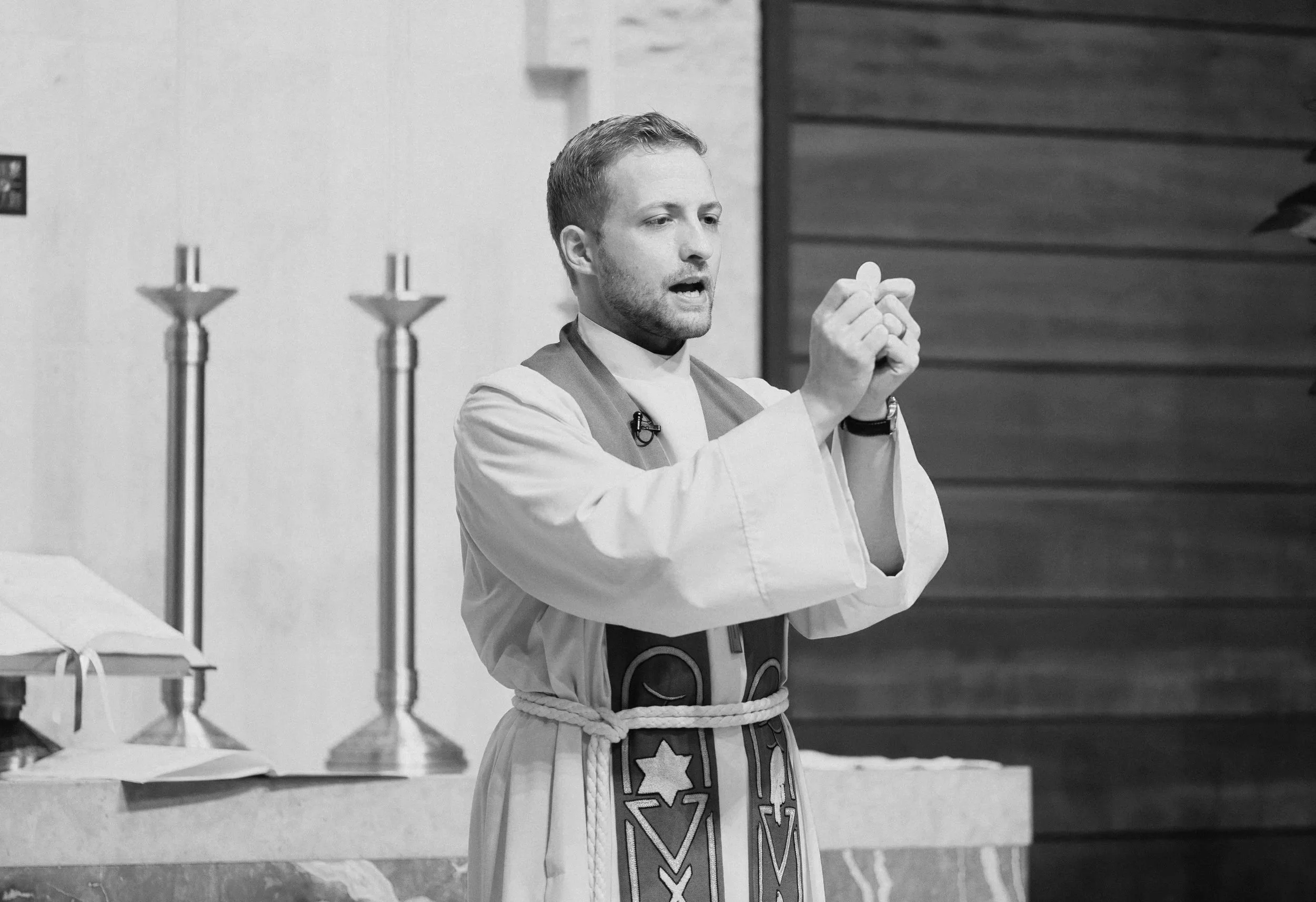
Jesus gives his body and blood for his church to touch and taste in, with, and under bread and wine. This is no mere metaphor or symbol, but a true, tangible, and sweet union of heaven and earth. By giving them his body and blood to eat and drink, Christ brings forgiveness, healing, and love to his people in what is called the Sacrament of the Lord’s Supper.
Finally, through the lives of his people, Jesus spreads the good news of a world being made new, inviting people to take their place in God’s greater story.
-
Jesus says, “Come to me, all you who are weary and burdened, and I will give you rest.” (Matthew 11:28)
You are not alone and you are not without hope. Come and discover how Christ can bring you true peace here at Saint James.
Our Creeds & Confessions
Saint James is a creedal and confessional Lutheran Church. We believe the Bible’s story is rightly summarized in the Church’s great ecumenical creeds—the Apostles’, Nicene, and Athanasian. Together with the creeds stand our confessions—rich and thorough documents that explain the Bible’s central teachings.